MODULE
E-1 ELECTRON THEORY
It has
been estimated that if two grams (0.070 ounce) of electrons could be
collected into two equal spheres and these spheres were a distance of
0.39" apart, they would repel each other with a force of
320,000,000,000,000,000,000,000 tons. A force greater than the weight
of the water in all the oceans of the world.
Insulators are elements that have six or more valence electrons. These
electrons are very difficult to free and tend to catch any free
electrons. An atom is completely stable when its
outer valence is filled with 8 electrons and will resist any activity.
The atom with 7 valence electrons is the most active, always looking to
catch a free electron and is the best insulator. There is no such thing
as a perfect insulator. Considered to be the best insulators are glass,
mica, plastics, rubber, dry air, ceramics, and slate.
It has been estimated that a single electron moves rather slowly at a
rate of approximately 3 inches per hour at one ampere of current flow.
But the impulse of electricity is extremely fast. It is assumed that
the speed of the electrical impulse is 186,000 miles per second, which
is the speed of light. When one electron enters a conductor with
billions of electrons, the impulse must be fast to knock one out the
other end of the conductor and move billions to do so.
If you should attempt to count the electrons in one ampere of current
for one second, you would have to count 1000 electrons per second for
190 million years without stopping.
Water and electricity flow under very similar conditions. That is to
say, each of them must have a channel, or conductor, and each of them
requires pressure to force it onwards. Water however, being a tangible
substance, requires a hollow conductor; while electricity, being
intangible, will flow through a solid conductor. The metal of the water
pipe and the insulation of the electric wire serve the same purpose;
namely that of serving to prevent escape by reason of the pressure
exerted.
Module E-1
Sample Clip
Back to the Learn to be an
Electrician Program
Module E-2 OHM'S LAW
Ohm's
Law is one of the most important things that you will use throughout
your electrical career. It is a mathematical tool which is of the
greatest use in determining an unknown factor of voltage, current, or
resistance in an electrical circuit in which the other two factors are
known.
Directly proportional means that one factor will be increased in
proportion to a decrease in another factor.
Example:
The current increases to two amps as the voltage increases to 2 volts,
The resistance remained the same; one ohm.
Inversely
proportional means that one factor will be increased in proportion to a
decrease in another factor or vice versa.
Example:
The current will increase in proportion to a decrease in resistance.
The current doubled to 20 amps with a decrease in resistance to 0.5
ohms.
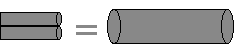
Doubling
the cross-sectional area of a conductor will reduce the resistance of
the conductor by one-half.
Put
your finger on the one you want to solve and the other two knowns will
show you how to solve it.
Back to the Learn to be an
Electrician Program
Module
E-3 MAGNETISM AND ENERGY
The
story is told that in the year 500 B.C., a shepherd boy who lived in a
Greek town named Magnesia, often used a walking stick with an iron tip
to help him climb the stony hills. One day the tip of his walking stick
actually stuck to a stone. He reached down and felt the stone. It
didn't feel sticky, and nothing else was attracted to it. Only the iron
tip of his stick clung to the rock. This rock is called a loadstone.
|
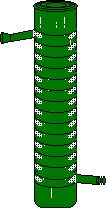
The picture to the left shows the relationship of
induction to water. When a garden hose is wrapped around a post several
times, the coiling will oppose the normal flow of water to slow it
down. A plumber refers to this as back pressure, like a restriction to
the flow. Electrically it offers a resistance to the normal flow of
current. We call it inductance. |
The
carbon brush, as it slides on the revolving commutator, reverses the
connections of the connection in the armature to the external circuit
at the instant when the voltage of the conductors is zero and changing
in direction. The commutator switches the wires outside the generator
while the armature turns, thus keeping the current flow in the same
direction at all times. If a commutator is not used, the current coming
out of the generator will change direction as the armature turns.
As the conductor cuts through the magnetic lines producing the torque
to rotate the motor, it acts like the force that the wing of an
airplane feels as it lifts. The top of the wing feels a lower pressure
than the bottom. This lower pressure is what causes the wing to create
lift, enabling the plane to become airborne.
I like to think of the secondary winding as a baseball catcher's mitt.
As the alternating current reverses direction through the primary
winding, an electron is induced into the invisible magnetic field and
the catcher's mitt (secondary winding) catches these electrons.
The tendency of matter to resist change is called inertia (in
nur sha). The word inert means sluggish to change and lackadaisical.
The animating force that prevents inertia from taking over is called energy.
The Law of Conservation of Energy states that energy is neither created
nor destroyed. The total amount of energy in the universe always
remains the same.
The pages of an old book turn yellow after years of time. The pages of
the book are slowly releasing chemical energy as they combine with the
oxygen of the air surrounding the book. The pages actually become
hotter than the surrounding air and the yellowing of the pages is a
result of this slow burning from chemical energy.
100w

If
you have trouble relating to six trillion watts, a human being operates
on 100 watts. The brain 20 watts and the body 80 watts. You are
equivalent to a 100 watt light bulb.
Module
E-3 Sample Clip
Back to the Learn to be an
Electrician Program
Module
E-4 SAFETY & TOOLS
Anyone
working in construction is exposed to potentially dangerous conditions
and situations. However, it is possible to complete hundreds of jobs
without any injury whatsoever. This goal of safety only requires that
anyone working in construction to be aware of the main sources of
danger. Not knowing the possible sources of danger, or worse, being
inattentive to those sources are the main reasons there are injuries in
construction work. You must take the proper precautions and practice
the basic rules of safety - one must be safety conscious at all times,
and this safety consciousness must become second nature to you.
OSHA'S new standard is a set of regulations aimed at
protecting the construction industry's five million workers. Falls
are the leading cause of worker fatalities,
accounting for more than 218 job related deaths per year. I once read a
safety poster which read: "You can walk with an artificial leg, you can
chew with false teeth, but you can't see with a glass eye."
Most people think that high-voltage is the main cause of fatal
electrocutions. Actually, it's the amount of current passing through
the body that determines the effect of a shock; currents over 15 mA are
dangerous, over 75 mA could be fatal. Of course the higher the voltage,
the more chance there is of pushing more current through the body.
The U.S. Consumer Product Safety Commission estimates that 110,000
people receive emergency hospital treatment each year for serious
injuries due to misusing simple hand tools.
Your mind and your hands work together as the message flows from your
brain to your hands to your tools. Once you become trained and have
practice, it will be a natural reflex. It will be like riding a
bicycle; once you learn it and apply it, you'll never forget it.
Connections can be over-torqued as well as under-torqued. The
inch-pounds of torque required by the manufacturer is the ideal value
that must be achieved as closely as possible to get the most effective
electrical connection, minimizing creep and cold flow of the conductor
metal and prevent overheating due to increased contact resistance.
When joining two pieces of wood of different thicknesses, drive nails
through the thin piece into the thick one. Use nails three times as
long as the thickness of the inner piece so that two-thirds of their
lengths will be anchored. For more security, drive nails at angles,
slanting away from one another. For maximum holding, drive a longer
nail through both pieces and hammer the protruding point over.
 1000v
Not all tools with plastic coatings or handles provide protection
against electrical shock. Many tools have plastic handles that are
designed solely for extra comfort. Use only tools that are marked with
the official international 1,000 volt rating symbol.
1000v
Not all tools with plastic coatings or handles provide protection
against electrical shock. Many tools have plastic handles that are
designed solely for extra comfort. Use only tools that are marked with
the official international 1,000 volt rating symbol.
The regular conduit hand bender gives more of a sweep in the bend. The
one-sweep design permits pinpoint precision even by the inexperienced
users. Both of these hand benders will bend EMT, IMC, and rigid metal
conduit. Bending larger conduits over 1" is done with a hydraulic
powered bender.
When carrying a long, heavy ladder, it's always a good idea to mark the
center (balance point) with tape or paint. When you pick up the ladder,
reach for the marked area and you'll be surprised how much easier the
ladder is to handle.
Module
E-4 Sample Clip
Back to the Learn to be an
Electrician Program
Module E-5 WIRING METHODS RESIDENTIAL
The
term loadcenter is used to describe a light-duty type of panelboard
used for residential and smaller commercial and industrial applications.
A conductor can be round, solid, stranded, rectangular, copper,
aluminum, etc. An example of a rectangular conductor would be the
busbar in a panelboard that the breakers connect to. The plans are the
roadmap of the work to be done. Persons unfamiliar with the symbols and
specifications find the plans difficult to follow. An experienced
electrician will actually make his own plans for certain jobs.
In some cases, instead of having a ceiling fixture, split-wired duplex
receptacles are used. By removing the tab on the hot side (brass
colored) of the duplex you split it into two circuits. One half of the
duplex will remain hot from the black wire and the other half will be
energized from the red wire which is connected through the single-pole
switch. This requires a 3-conductor cable between the receptacles. This
will be further explained in detail later in this module.
The location of the service to a building is extremely important as
this is where the big money is spent.
The service can be overhead or underground. The key in a residence is
to locate the service and panelboard close to the heaviest loads. The
heaviest loads would be the highest wattage appliances such as the
range, water heater, clothes dryer, air conditioner, electric heat, etc.
These appliances require the larger size cable which is the money
factor. Always try to keep these circuits at a minimum distance from
the panelboard.
A garage that is close to the kitchen is an excellent location for the
panelboard.
When you place devices in a box, the stiffness of the wire can
sometimes cause one or more connections to loosen slighty. Loose
connections have resulted in overheating, arcing, and fires. Always
fold the wires carefully so when installing the device you will not put
any pressure against the connections. Don't use a box too small.
To make it real simple, you can't have a neutral in a 2-wire (120 volt)
circuit. You must have a 3-wire circuit and read a voltage potential
between the hot wires.
A despard-type device is small in size, as up to three devices may be
mounted in a standard device box. They are easily mounted in the same
strap, and then the strap is mounted to the device box.
Module
E-5 Sample Clip
Back to the Learn to be an
Electrician Program
Module
E-6 WIRING METHODS COMMERCIAL
The
wiring methods used for commercial and industrial buildings generally
require the wires to be installed in some form of raceway. The Code
defines a raceway as: An enclosed channel designed expressly for
holding wires, cables, or busbars.
An auxiliary gutter serves the same function as a long junction box
would. Sometimes it is necessary to run large conductors for a short
distance but to make several taps to the conductors, in the case of
multiple services.
There are five types of conduit that must be properly bent, in the
field, by the installer to form the complete conduit system with each
type having its own unique features. Electrical metallic tubing (E.M.T.
or thinwall), rigid steel conduit (rigid), intermediate metal conduit
(IMC), rigid aluminum conduit, and polyvinylcholoride (PVC) conduit.
Each type of conduit has a different wall thickness, but the internal
diameter is approximately the same.
I have even used a nylon string in tight places to cut the PVC. By
see-sawing the string back and forth, the friction created actually
cuts the plastic conduit.
The effective grounding path is like a chain. It is as strong as its
weakest link. The mechanical connections of conduits and boxes are a
vital factor in the strength of the grounding path.
Sometimes a box is added in a wall where there is no stud to mount the
box to. Drywall is not strong enough to support screws so a special
pair of metal straps are used to secure the box in the wallboard.
Insert one strap on each side of the wall opening for the box, and push
the box into the opening. Then bend the short ends of each strap down
into the inside of the box. Be sure they are bent back sharply over the
edge of the box, and lie tightly against the inside walls of the box,
so they cannot touch the terminals of the device being installed. These
straps are called, by the electrician, "madison straps" or "hold-its".
A basic color code, numbering system, and case color system is used to
identify the load level or strength. The powder charges are numbered 1
through 6 with 1 being the weakest. The powder charges are also color
coded using 1-grey, 2-brown, 3-green, 4-yellow, 5-red, 6-purple. The
case colors are brass and nickel.
A hickey-type hand bender generally is used for rigid conduit sizes 1"
and smaller. A 90° bend is made by making several gradual segment bends
(approximately 10° at each position) sliding the bender along the
conduit and bending in small amounts. For larger sizes of rigid conduit
a hydraulic bender is used. This is a popular bender for kicking the
stub-up back into the wall.
Offsets and saddles are easier to bend with the handle of the bender
placed on the floor with the bender up at waist level. Bend the conduit
by putting pressure on the conduit close to the bending shoe. Bending
the conduit with pressure close to the bending shoe, forces the conduit
between the supporting walls of the shoe, which keeps the conduit from
kinking, and in this position, it's easy to see the degree marks on the
bender and accurate bends can be made.
On large conduit jobs where there are many long runs, electric
blower/vacuum equipment is used which will quickly either blow or pull
a fish line through the conduit. The fish line is then used to pull a
pulling rope through the conduit and the wires are connected to the
rope.
An electrical connection that is overtightened can cause several
problems. Overtightening can flatten the conductor to a point that it
breaks. Overtightening the connection can also cause the connection to
heat up. The conductor will push away from the stud area causing the
conductor to cup which reduces the amount of contact with the lug. This
smaller contact area causes overheating just as a loose connection
will. Overtightening can damage the lug by causing small hairline
cracks in the lug.
Signs
of trouble in aluminum wire systems include warm-to-the-touch
face plates on the receptacles or switches, flickering lights, circuits
that don't work, or the smell of burning plastic at the receptacles or
switches. Unfortunately, not all aluminum wired connections provide
such easily detected warning signs; aluminum wired connections have
been reported to fail without any prior indications or problems.
Ground fault receptacles are used often when only the one outlet is to
be protected, such as in a bathroom at the sink or a kitchen counter
receptacle. This type of receptacle can provide ground fault protection
for only its outlets or it can be wired so that other outlets down
stream can be protected by the same receptacle. A test button is
provided to trip the receptacle intentionally to insure the proper
operation with a reset button to restore the power to the receptacle.
Fluorescent lamps were first introduced in 1938 and operate totally
different from incandescent lamps. When a substance is exposed to rays
such as X-rays or ultraviolet rays and emits light as a result of this
exposure, the substance is said to be fluorescing. Fluorescent lamps
use less energy than incandescent lamps. Fluorescent lamps convert
approximately 23% of its input energy to light, and incandescent lamps
only convert 11% to light.
Module
E-6 Sample Clip
Back to the Learn to be an
Electrician Program
Module
E-7 THE SERVICE
As an
electrician it is very important that you understand the definition of
branch circuit, feeder, service, etc. as the design rules change on
each part of the system. A panelboard provides overcurrent protection
for the circuits contained within.
A panelboard generally contains a means for switching the circuit on or
off. Some of the older panelboards have a snap switch and a fuse. Most
panelboards today contain circuit breakers which provides both
overcurrent protection and a means for switching the circuit.
System grounding means that the service neutral conductor, grounding
electrode conductor, service entrance equipment, and all metallic
pipes, must be bonded together at the service. The equipment grounding
conductor, or raceway, is bonded to the neutral and grounding electrode
conductor at the neutral block in the service equipment panel only.
The number one violation of grounding is the bonding of the grounded
neutral at sub-panels and other locations throughout the electrical
system.
The difference between an installer and an electrician is education. An
electrician is taught that a circuit must also not work at certain
times. This is called protection (safety). This is as important as the
circuit working.
Whereas a ground fault current normally falls within one and six times
the normal current, the short-circuit current is quite high. The
short-circuit or fault current can be many hundreds of times larger
than the normal operating current. A high-level fault current may be
50,000 amperes or larger. If not cut off within a matter of a few
thousandths of a second, destruction and damage can become severe;
insulation damage, melting of conductors, arcing, and fires.
Panelboards which are designed to accept tandem breakers are designed
so the mounting cam on the tandem breaker can only be installed in a
position that has a mounting pan rail slot which will accept the cam.
This prevents the panelboard from having over 42 overcurrent devices.
The lug may be rated for 90°C but this does not give permission to the
installer to use a 90°C conductor at 90°C ampacity. Every electrical
component in the entire circuit must be 90°C rated.
When
applying the variables to circuit designing often it is required
to use a larger conductor for voltage drop, ampacity corrections, etc.
The question that comes up is how can you properly install a #4
conductor to a 20 amp circuit breaker? The terminal lug isn't big
enough. UL listed splicer/reducer lugs are available for this purpose.
Module
E-7 Sample Clip
Back to the Learn to be an
Electrician Program
Module
E-8 GROUNDING
Sometimes
too much emphasis is put on one's knowledge of Code rules and sizing of
bonding jumpers, electrode conductors, etc. Before one can discuss
proper sizing of grounding conductors you must first understand the
reasons for grounding a system, theory, Ohm's law, and what takes place
when a fault condition occurs in the system.
When a conductor or metal object is connected to an earth electrode, it
is forced to take the same zero potential as the earth. Any attempt to
raise or lower the voltage of the grounded object results in current
passing over the connection until the potential of the object and the
potential of earth are equal.
Under normal conditions, the current flow would be the same in both
wires. But with a ground-fault leak to metal conduit, the current in
one wire does not equal the current flowing in the other wire. When
this happens, the induction in the secondary winding of the transformer
will cause the sensing unit to operate the GFCI.
Today, plugs and receptacles are polarized, which means the pins on the
plugs and receptacles are opposite in size so they can only be plugged
one way into a receptacle.
Grounding is not only to keep
enclosures and equipment at earth potential, but also to provide a path
of low-impedance back to the source to allow enough current to flow to
operate the overcurrent device (fuse or circuit breaker) when a fault
occurs.
If an overcurrent protective device opens a short-circuit current in
less than one-half cycle, (before it reaches its total available
value), the device is a "current limiting" device. If not limited,
short-circuit currents can reach levels of 30,000 to 40,000 amperes or
higher in the first half cycle of a 60 cycle AC circuit. The heat
produced in the circuit by the immense energy of short-circuit currents
can cause severe insulation damage or even an explosion.
The terms earth and ground are often misused in our electrical industry
today. The words seem almost alike, but are not. An airplane 35,000
feet up in the sky has a ground bus and grounding conductors, etc. but
the airplane is not connected to earth. To use earth and ground as the
same meaning is obviously in error.
Module
E-8 Sample Clip
Back to the Learn to be an
Electrician Program
Module E-9 MOTORS-BOX & CONDUIT FILL
After
the hermetic motor-compressor sits idle for a period of time, the
refrigerant reaches a temperature of that of the ambient and provides
poor cooling for a short period of time on start up. Consequently, the
motor heats up faster than an ordinary motor. This is the reason for
the different rules of Articles 430 and 440.
Circuit breakers suitable for heating, air conditioning, and
refrigeration equipment comprised of multimotor or combination loads
are labeled HACR type.
HACR type circuit breakers are the same as other type inverse-time
circuit breakers, except they have been additionally investigated by UL
and determined to be suitable for motor branch circuit protection on
group installations. The additional investigation includes tests to
determine if the circuit breaker affords an appropriate level of
protection for the circuit components. UL testing is performed on
circuit breakers and equipment intended for use with HACR circuit
breakers.
A motor is designed to allow for a temporary overload when the motor is
required to deliver more than its rated horsepower only for a short
period of time. If this overload would continue, then the overload
which senses this increase of current (heat) will open, thus protecting
not only the motor but also the wiring.
Shown below is a main wiring diagram of a three-phase magnetic motor
starter with 3 thermal overloads. The starter is controlled by a
start-stop push button control circuit using the holding circuit. The 3
overload interlocks  are connected in series with the coil. The 3 thermal overloads
  are connected in
series with the motor. The control wires are shown in a fine line, the
power wires in a heavier line.
are connected in
series with the motor. The control wires are shown in a fine line, the
power wires in a heavier line.
We now need to learn how to calculate the maximum
number of wires the Code allows in a box or conduit
Note:
Each strap holding a device (switch or receptacle) counts as two
conductors, if the strap holds a duplex or triplex receptacle, it still
counts as two conductors.
The number and size of
conductors in any raceway shall not be more than will permit
dissipation of the heat and ready installation and withdrawal of the
conductors without damage to the conductors or to their insulation.
Even though a GFCI receptacle is larger than a standard duplex
receptacle and a dimmer switch is larger than a standard single pole
switch, the Code still counts them as the same size device in
calculating box fill.
Module
E-9 Sample Clip
Back to the Learn to be an
Electrician Program
Module E-10
INSPECTION-MAINTENANCE-TROUBLESHOOTING
After
the equipment has been installed and connected, it is the electricians
job to test the wiring to see if it has been installed properly. Tests
will verify that the wiring, receptacles, switches, and light fixtures
are all operating correctly. These tests are very important, as they
will reveal any defects in the wiring or equipment.
Troubleshooting involves both visual inspection and electrical testing.
Troubleshooting is locating the problem once it occurs. Should the
tests you run on a circuit indicate that it is not operating correctly,
then you will perform various troubleshooting procedures that will help
you locate the problem.
Signs of violent corona when a substation is energized should be
reported. Corona is an electrical discharge phenomenon occuring in
gaseous substances such as air. High electrical pressure exceeding the
breakdown level of air lead to corona discharges. Mild corona will have
a low sizzling sound. As it increases, the sizzling sound becomes
louder and will have sounds of popping and crackling as flashover level
nears. Corona ionizes the air, converting the oxygen to ozone, which
has a distinctive odor. Mild corona may be normal and be more
noticeable when humidity is high.
Proper bolt tightness torque values for all types of joints involved
should be available in manufacturer's maintenance and instructional
literature. The Code requires in section 110-3b that all electrical
equipment is to be installed as listed, and this requires torquing the
connections.
Installing more than the Code maximum permitted conductors in a box has
caused accidents and fires. Forcing the receptacles into a crowded box
tends to loosen the connections thus resulting in a high resistance
fault (heat).
As pinholes or cracks develop, moisture and foreign matter penetrate
the surfaces of the insulation, providing a low resistance path for
leakage current. Now the insulation which was good has become a partial
conductor.
Schematic diagrams are arranged for simplicity and ease of
understanding circuits without regard for the actual physical location
of any components. The schematic is always drawn with contacts shown in
a de-energized position.
Dim or flickering lights, arcs or sparks, sizzling or buzzing sounds
from the electrical system, odors, hot switch plates, loose plugs and
damaged insulation, among other things, are signs of potential hazards.
Module
E-10 Sample Clip
Back to the Learn to be an
Electrician Program