Statewide
electrical licensing and continuing education are becoming more and
more common throughout the United States.
Contact
your local Building
Department or official to find out current license
requirements for your area. For information about continuing education
units, check out our electrical
seminars.
Exam
questions come from theory, common
knowledge, and the National Electrical Code© which
would be the same in any state. The main difference in testing in
different states are the questions involving state and local laws and
rules. Check out our list of frequently
asked questions about licensing and the electrical exam.
Some
states are now requiring an exam on Business and Law for the
contractors license.
The
major purpose of a license is to protect public health and safety by
preventing unqualified people from practicing a given profession or
occupation. Licensing is also a formal and legal way of defining a
profession and a means of including, in practice, those who meet
predetermined standards deemed to be necessary for the protection of
the public.
Licensing
is more than passing an exam and paying a fee; it is being held responsible
and liable to penalties for incompetence or illegal/immoral actions.
Having a license suspended or revoked is not only to punish and to
avoid repetition of improper acts, it is to protect the general public.
After
passing the exam there are requirements that
must be met in most States. These requirements must be kept up to
maintain your license. All licenses, regardless of issuance date, are
subject to renewal, on a given date by the State. Failure to maintain
the requests can cause automatic termination of the license.
Worker's
Compensation Insurance - Submit a certificate of
worker's compensation insurance from an insurance company authorized to
do business in this State, and a statement from the insurance carrier
that the board will be notified of any withdrawal, termination, or
cancellation of the insurance.
Liability
and Property Damage Insurance - Submit a certificate of insurance from an
insurance company or agency authorized to do business in your State,
showing full policy coverage of the applicant for comprehensive
personal injury and property damage liability. The dollar amount will
vary from State to State.
Place
of Business - A licensed contractor shall
have and maintain a definite place of business where the license may be
served notice and legal process in the State within an area zoned for
such business and shall display therein his contractor's license. A
Post Office Box number is not accepted as a place of business.
Fees
- License fees will be due.
Specific amounts will be given at the appropriate time.
The
difficulty for some taking an exam is the questions come from
a broad area of the electrical trade and are not necessarily
limited to only the type of electrical work that you perform. For a
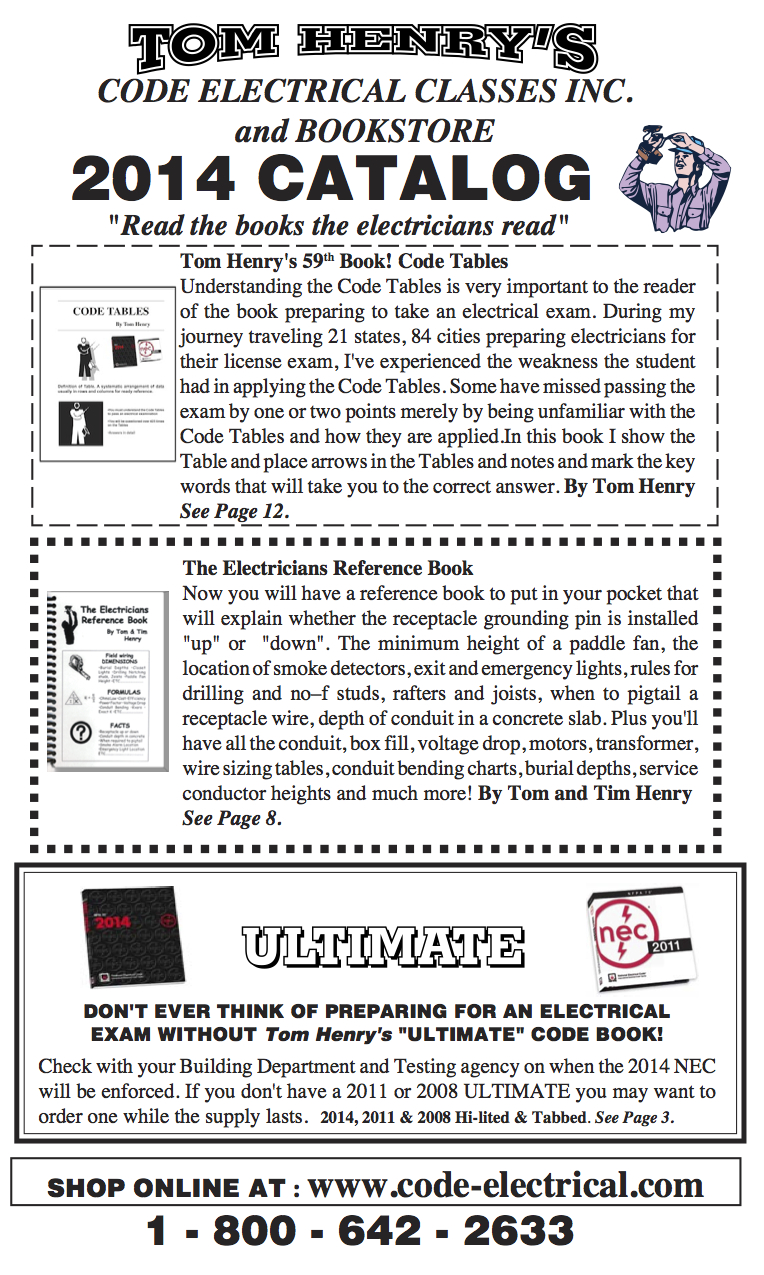
list of books and DVDs
to help you prepare for the journeyman and master electrical exam as
well as the business law exam, check out our current catalog.
The
exam is written for any electrician that sits for the test that
particular day. You may only wire houses, but the electrician
sitting behind you only wires hospitals or gas stations. Some exam questions
may come from areas of the Code book you've never used in your work.
Local
exams sometimes don't fully evaluate ones craftsmanship and knowledge
of the electrical trade. National testing organizations have
incorporated the latest technology. A task analysis is used to develop
a test that is a fair test of ones knowledge in the electrical trade.
A
task analysis is performed by a committee of competent experts in the
electrical field. A field survey of tradespeople performing the tasks
in the field is listed in an outline with the degree of each task
evaluated and used in the exam.
Sure,
I heard all the negatives of being required to take an exam over the
years. The statement that always appears in my mind was said by Vince
Lombardi: "Winning isn't everything, but it sure beats the
second choice".
The
time has come to demand accountability and it starts with you. Demand a
license.
Written
exams whether written by a testing company, licensing board, or by the
electrical inspector are generally based on the same categories of
questioning: Code, theory, practical knowledge, etc.
The percentage of questions asked from the category may vary due to the
exams being customized to meet the requirements for the area in which
the exam is being given.
Some
exams require a larger or smaller percentage of questions asked from a
category than another area requires. This decision is made by the
electrical board members of that area.